NFRC Thermal Analysis
Simulation-Based Ratings That Hold Up Under Product Approval Review and Energy Code Scrutiny
NFRC-compliant simulation and determination of whole-product U-factor, Solar Heat Gain Coefficient (SHGC), Visible Light Transmittance (VLT), and Condensation Resistance (CR) — for every product configuration, backed by licensed engineering oversight.
The National Fenestration Rating Council (NFRC) establishes the simulation methodology and labeling standards that govern how windows, doors, and skylights are rated for thermal performance in the United States. Qrown Engineering's thermal analysis service delivers NFRC-compliant U-factor, SHGC, VLT, and CR determinations for each product configuration — supporting Florida Product Approval (FPA), ASHRAE 90.1 compliance, and energy code verification across all licensed states.
Using THERM finite element analysis software and WINDOW simulation tools — the same platforms recognized by NFRC and DOE — we evaluate every critical thermal bridge, edge spacer interaction, and glazing system parameter to produce accurate, defensible ratings. Each analysis is reviewed and documented under licensed PE oversight, providing the engineering authority that product approval agencies and building officials require.
The rate of heat transfer through the entire fenestration product — frame, edge-of-glass, and center-of-glass — per unit area per degree of temperature difference. Lower U-factor values indicate better insulating performance. Typical range: 0.20 – 1.20 BTU/hr·ft²·°F.
The fraction of incident solar radiation admitted through the fenestration product, including directly transmitted and absorbed-then-released heat. Values range from 0 to 1. Lower SHGC reduces solar heat gain — critical for cooling-dominated climates like Florida.
The fraction of the visible light spectrum (380–780 nm) that passes through the glazing system. Higher VLT values mean more natural daylight. VLT is evaluated independently of SHGC, allowing optimization of light-to-solar-gain ratios in high-performance glazing systems.
A measure of a fenestration product's ability to resist interior surface condensation under cold exterior conditions. Rated on a scale of 0 to 100 — higher CR values indicate better resistance. Particularly relevant in high-humidity climates and cold-weather states including NY and NJ.
Simulation-Based Ratings That Hold Up Under Product Approval Review and Energy Code Scrutiny
NFRC-compliant thermal ratings for product lines seeking Florida Product Approval (FPA) or targeting specific energy code compliance thresholds. Per-configuration analysis supports a full product matrix from a single engagement.
Independent verification of manufacturer-supplied ratings, energy code compliance gap analysis, and glazing system consultation to meet ASHRAE 90.1 or IECC prescribed path requirements on your specific project.
Product selection guidance backed by simulation — not just marketing data. Understand the actual thermal performance of your specified fenestration assemblies before procurement, and ensure compliance before permit review.
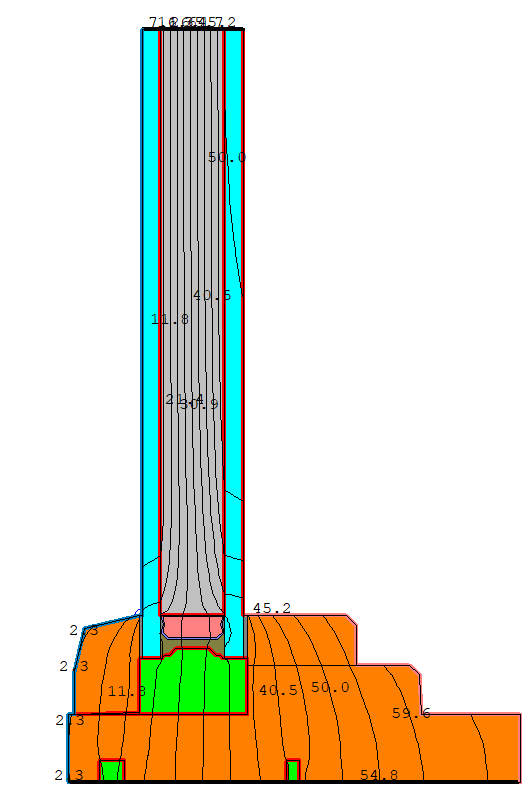
Representative NFRC simulation outputs — the same type of analysis deliverables produced for each product configuration submitted for rating.
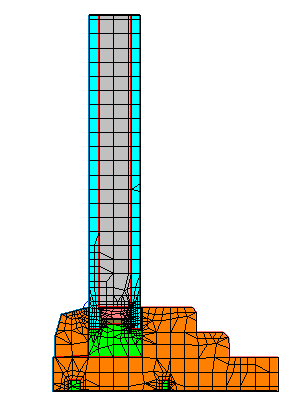
2D FEA mesh of a window sill cross-section — the foundation of every NFRC U-factor and SHGC simulation. Each material layer and thermal bridge is modeled at the node level.
Isotherm plot showing the temperature distribution across the fenestration cross-section. Contour lines identify thermal bridging locations and cold spots that drive condensation risk.
Share your product type, frame material, glazing assembly, and configuration matrix — and we'll scope out the full thermal analysis engagement.